
Meet David Wunder, the 2026 Heizer Doctoral Dissertation Award Winner
The Heizer Doctoral Dissertation Award in New Enterprise Development recognizes outstanding doctoral research in entrepreneurship and new venture development.
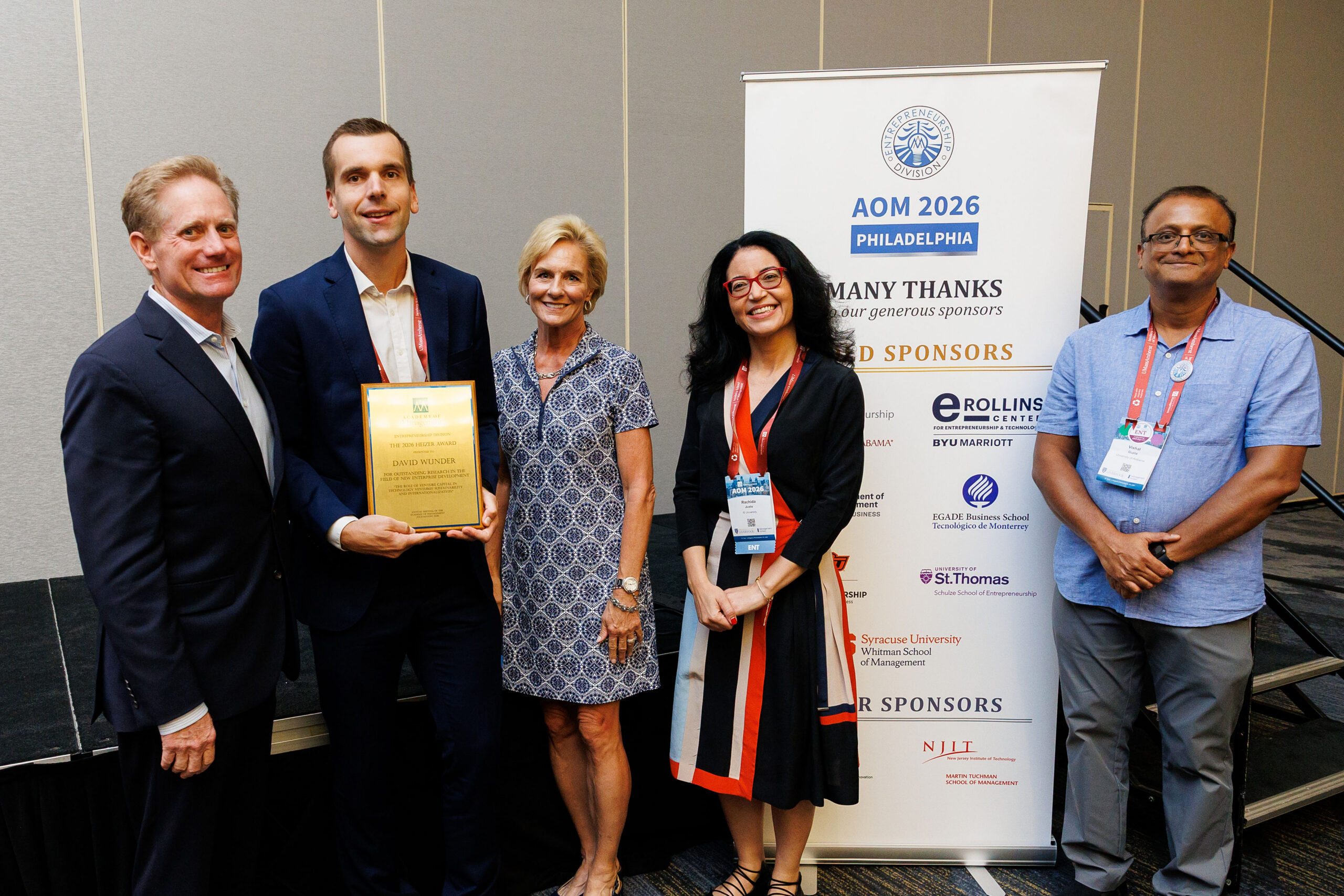
We invited David to tell us more about his research, what inspired his dissertation, and the insights he hopes to bring to the field.
Congratulations! You recently received the 2026 Heizer Doctoral Dissertation Award. What makes this recognition especially meaningful?
The Heizer Award has recognized dissertations in new enterprise development for over 50 years, so it means something to be added to that list. What I particularly appreciate is that practical relevance is one of the awarding criteria. I have always wanted to work on questions that matter to both the academic literature and the entrepreneurs making these decisions.
For those outside your research area, tell us a little about your dissertation. What question were you trying to answer, and what did you find?
Technology ventures depend on venture capital (VC) investors for more than money. As these investors can provide networks, market knowledge, and technical expertise, which investor a venture takes money from matters. I studied this across European VC-backed ventures between 2000 and 2019.
One finding is that corporate VC investors cross borders frequently, and they invest abroad where the venture’s technology complements what the corporate parent already does. So it is important to consider different investor types when thinking about cross-border VC.
Another finding concerns what happens after a cross-border VC investor invests in a technology venture. My findings suggest that these investors affect different steps of the innovation process, from where inventions are made to where technologies are protected and commercialized. Cross-border VC investors therefore do not just push a venture to internationalize its technologies faster, they also shape the direction, with foreign-oriented innovation activities running towards the investor’s home country.
Was there anything in your findings that particularly surprised you or that you think entrepreneurs should pay attention to?
What I did not anticipate was how consistently cross-border VC investors direct technology ventures’ innovation activities towards their own home market. In the current version of that paper, I find that ventures protect more of their technology in the investor’s home market after a cross-border investment, are more likely to have inventors and co-applicants from that market, and are more likely to establish a subsidiary there.
For entrepreneurs, I think that cuts both ways. If the investor’s home market is where you want to grow, their network and knowledge are a real asset. If your strategy points elsewhere, you can be pulled towards whichever resources are easiest to reach. One practical implication is that it is worth checking whether an investor’s geographic expertise actually overlaps with your intended markets.
What’s next for you and this research?
I am now a postdoctoral researcher at Hanken School of Economics, still working on questions close to the dissertation. I have also started working on a new project on acquisitions of sustainability-oriented entrepreneurial ventures. It shifts the focus from who funds these ventures to who ends up buying them, which raises a different set of questions.